

Qi Technology – How Wireless Charging Works
What Is Qi Technology? – A Definition
The term “Qi” refers to an open, globally leading standard for wireless charging of mobile devices. This standard was first published in 2010. The term is typically pronounced “chee” (Chinese for “life energy”).
Today, Qi technology is firmly established internationally and is largely responsible for the widespread adoption of inductive / wireless charging. Thanks to it, companies and consumers can rely on chargers and end devices from a wide range of brands working together.
For example, a Qi-certified smartphone can generally be charged with a Qi-certified charger from another manufacturer. At the same time, Qi technology also ensures that the devices involved in the charging process are protected from damage – such as overcharging, overheating, or short circuits.
Qi technology is managed and developed by the Wireless Power Consortium (WPC) and its members, which include many major electronics manufacturers.
How Does Qi Technology Work? – The Principle
Wireless charging almost feels like magic: simply place your smartphone on the charging pad and the battery starts charging, even though no cable is plugged in. Behind it, however, is a relatively simple physical principle. Qi technology uses electromagnetic induction – the transfer of energy through a magnetic field over a very short distance.
How Inductive Qi Charging Works
A Qi-certified charger contains a copper wire coil. This is typically referred to as the “transmitting coil.” When the charger is supplied with power, that coil generates an alternating electromagnetic field.
The device being charged – for example, a smartphone – contains a second coil known as the “receiving coil.” If the two coils are close enough to each other, the magnetic field induces an electric current in the receiving coil.
That current is converted by the smartphone’s charging electronics into a form that can charge the battery. After that, all it takes is a little patience and the battery is full again. That is the basic principle in a nutshell.
What Happens Technically Between the Charger and the Smartphone?
Wireless charging does not start immediately at maximum power. First, the charger and the smartphone check whether they are compatible and what level of power can be delivered safely. In simplified terms, a kind of negotiation takes place:
- The charger detects that a compatible device has been placed on it
- The smartphone and charger negotiate the allowed charging profile
- Only then does the system gradually increase power
- Throughout the charging process, temperature, positioning, and energy flow are continuously monitored to ensure everything remains within a safe range
This form of coordination is an important part of Qi charging. Otherwise, the charger could, for example, deliver significantly more power than the smartphone can handle – which would very likely result in device damage. Qi technology actively prevents exactly these kinds of scenarios.
The Role of the Coils: Why Positioning Matters So Much
Wireless charging is generally considered less efficient than charging by cable – and that is partly true. The efficiency of the charging process depends heavily on how precisely the two coils are aligned with each other.
If the smartphone is tilted or placed too far away from the ideal position, several effects may occur:
- Charging may not start at all
- Charging may start and repeatedly stop again
- Charging power may drop
- The charging process may take longer
- More energy may be lost as heat
This issue was especially common in the early days of Qi technology – and it was not effectively solved until the introduction of the Qi2 standard, through a simple trick.
How Qi2 Works – and Why It Is More Practical
The new Qi2 standard adds magnetic alignment to wireless charging. That means the device and charger can find the correct position more easily.
For users, this brings several advantages:
- The smartphone sits more securely on the charger
- The coils are aligned more precisely
- Energy transfer becomes more efficient
- Charging power remains more consistent
In simplified terms, Qi2 is wireless charging with built-in alignment assistance. Instead of having to place the smartphone as precisely as possible in the correct charging position, magnetic alignment makes crooked or incorrect placement almost impossible.
The Advantages of Qi Technology
Easy charging without cables, based on a unified standard – some of the advantages of inductive charging are obvious. Many others are easily taken for granted today, so here are the most important benefits:
- Greater everyday convenience: The smartphone is simply placed on the charging pad instead of having to plug in and unplug a cable every time
- Less cable clutter: Qi technology is a direct answer to the tangle of charging cables – with inductive charging, most cables disappear into the drawer, making desks and other spaces look much tidier
- Cross-manufacturer compatibility: A Qi-certified charger can be used with many compatible devices from different brands. The standard ensures that users are not tied to specific devices or vendors
- Flexible use locations: Qi charging surfaces are available in many sizes, designs, and form factors, so they can be taken and used almost anywhere (office / home / car / on the go)
- Wide range of devices: The technology is suitable not only for smartphones but also for earbuds, many smartwatches, and other accessories – in simple terms, for just about all the electronics that are part of everyday life today
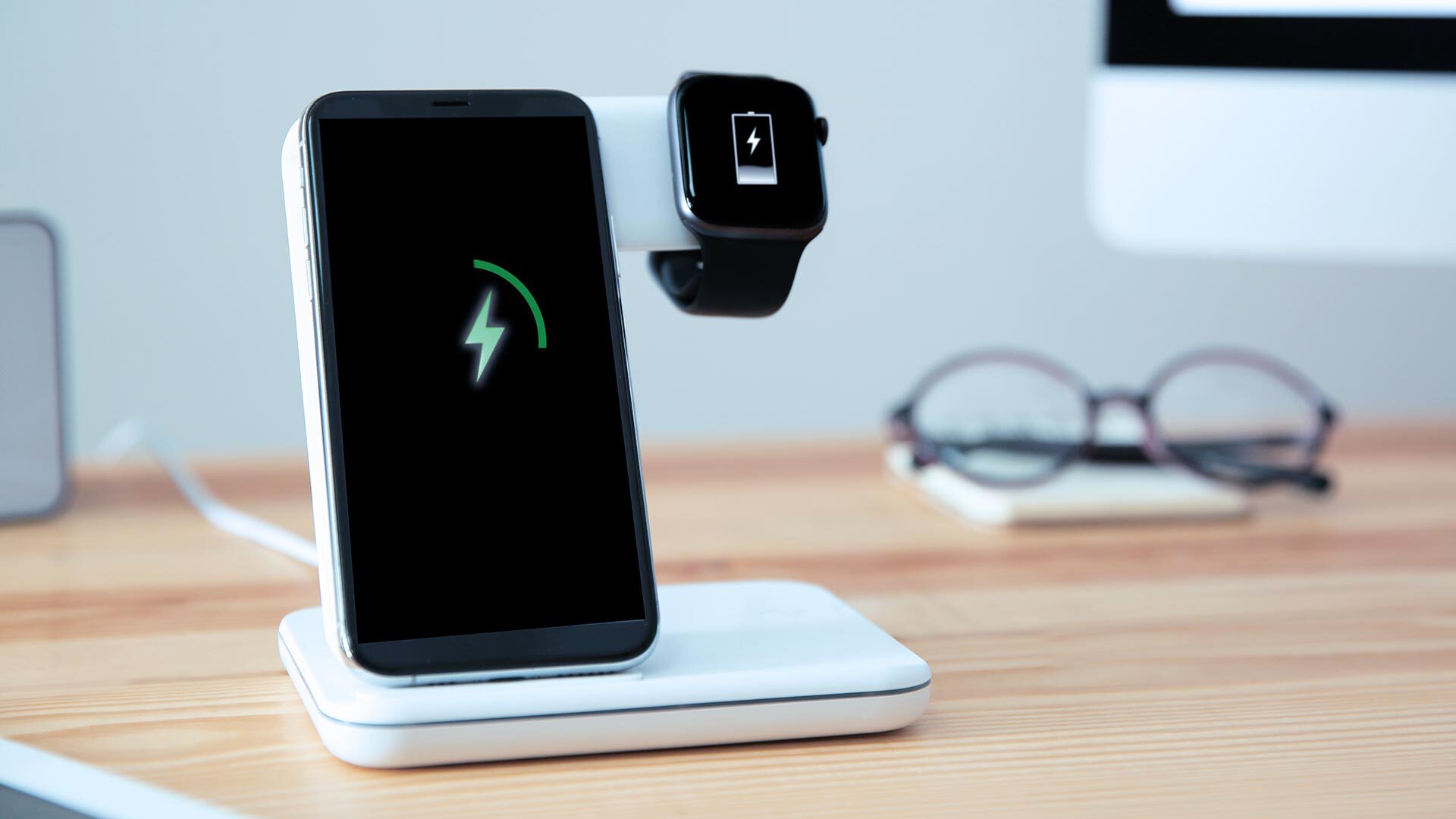
- Charge multiple devices at once: Depending on the charger or charging station, either one or several devices can be charged simultaneously
The major gain in flexibility users get from eliminating a physical cable is without a doubt one of the defining characteristics of Qi technology. At the same time, that added flexibility also comes with a few limitations.
Drawbacks & Limits of Qi Technology
Because of technological (and physical) constraints, there are still certain situations in which a “classic” cable remains the better choice than wireless charging:
- Lower charging speed: In many cases, wireless charging is still slower than modern wired fast charging – especially when users are short on time and effective charging power matters
- Higher energy losses: Because of inductive energy transfer, some of the energy is inevitably lost as heat. As a result, efficiency is lower compared with charging by cable
- Heat generation: Additional heat can cause smartphones to automatically reduce charging power in order to protect the battery and electronics from damage – an important protective mechanism, but one that slows down charging
- Dependence on positioning: The device must sit correctly on the charging surface (coil alignment). Even small misalignments can affect charging power and charging stability
Several of these issues are already being actively mitigated today – for example through continued standard development (higher charging power / magnetic alignment). Still, they are part of any complete assessment of Qi technology.
Which Devices Support Qi?
Qi technology is now supported by a wide range of modern devices, especially in the smartphone category:
| Category | Manufacturer | Qi | Qi2 |
|---|---|---|---|
| Smartphones | Apple | from iPhone 8 | from iPhone 12 (MagSafe) |
| Samsung | from Galaxy S6, Note 8, Fold & Flip series | from Galaxy S26, Fold 6, Flip 6 | |
| from Pixel 5 | from Pixel 10 | ||
| Wearables | Apple | every Apple Watch | |
| Samsung | from Galaxy Watch 3 | ||
| from Pixel Watch 4 | |||
| Headphones | Apple | from AirPods 2 | |
| Samsung | all Galaxy Buds | ||
The list above is not exhaustive and is provided for general information purposes only. It includes specific product lines from globally recognized consumer technology manufacturers. cetecom advanced GmbH maintains a deliberately neutral stance toward these companies.
Important: Especially in the headphone category, there are dozens of established providers such as JBL, Bose, Sennheiser, Sony, Huawei, and more with their own Qi-certified product lines. At the same time, there is more and more charging accessories such as power banks (from Anker and UGREEN) that can magnetically “attach” to the back of smartphones thanks to Qi2 support.
Can Qi Be Retrofitted to Devices?
Only to a limited extent. For older smartphones, the market often offers “Qi receivers” (small charging pads) or special charging cases that make a form of inductive charging possible.
However, the performance of these retrofit solutions is generally significantly below that of Qi-certified charging solutions. At the same time, very inexpensive retrofit kits can potentially pose a risk to the device – for example because they may lack overheating protection.
Because more and more manufacturers now support Qi charging natively, it is usually safer and more sensible to choose a compatible device with built-in Qi support right away.
What “Qi-Certified” Means – and Why It Matters
The “Qi-certified” label indicates that a charger or device has been tested by a laboratory officially recognized by the Wireless Power Consortium (WPC).
Among other things, Qi-certified products are tested for overheating, foreign object detection, and stable energy transfer – all factors that can affect charging safety.
At the same time, certification ensures that Qi-certified smartphones and chargers – as already described above – can communicate across manufacturers and therefore work together during charging.
It is important to distinguish this from terms such as “Qi-compatible” or “Works with Qi.” These labels are not protected and therefore are not a guarantee that, for example, overnight wireless charging will work without issue. That does not mean such products are definitely unsafe – but they have not been formally tested for safety.
FAQ About Qi Technology
How does the Qi certification process work?
To have a wireless product certified according to the Qi standard, companies must meet the following requirements:
- They must be a member of the WPC
- They must submit basic product information through the WPC’s certification system
- An Authorized Test Laboratory (ATL) tests a product sample for compliance.
- Once the conformity test is passed, the product is sent to the selected Interoperability Testing Center (IOC) for interoperability testing
- The test results are submitted to the WPC for review.
- The WPC reviews the submitted documentation and grants certification upon successful review
We are happy to support you throughout this process and help ensure the professional and expedited certification of your products.
How can I tell whether a product Is “Qi-Certified”?
If a device is officially Qi-certified, this is indicated by the official Qi logo. This is usually found on the product packaging. This logo may (legally) only be used on products that have been Qi-certified by an official body.
Helpful: Interested users can easily verify whether such wireless charging certification exists through the Wireless Power Consortium’s own database. All products worldwide that have undergone the corresponding certification are listed there.
Is Qi Charging harmful to the battery?
No, wireless Qi charging is generally not harmful to the battery of an electronic device. However, it is true that inductive charging generates more waste heat than traditional wired charging.
If the battery becomes too warm, this can impair its charge capacity and cause the lithium-ion battery to age prematurely. Many manufacturers – especially industry giants such as Apple and Samsung – already rely on their own “smart charging” solutions to reduce strain on smartphone batteries and more.
Why does Wireless Charging generate heat?
Wireless or inductive Qi charging is very convenient in everyday life, but from a purely physical standpoint it cannot be completely loss-free. Some of the energy exchanged between charger and smartphone is lost along the way – especially in the form of heat.
A little additional heat is entirely normal for wireless charging / Qi wireless charging. It only becomes problematic if, for example, the charger and smartphone do not communicate correctly or if protective logic inside the electronics fails.
Is Qi Wireless Charging possible with a phone case?
Often yes – but not always equally well. Since very few users are willing to remove their phone from its case just to charge it, most phone cases today are already designed to allow wireless charging.
Very thick cases or “outdoor cases,” however, are not necessarily suitable for Qi charging – but in most cases, whether a particular case supports it is clearly indicated for the user.
What Is the Difference Between Qi, Qi2, Qi2 25W, and MagSafe?
“Qi” refers to the original wireless charging standard managed by the Wireless Power Consortium. Initially, it supported charging power of up to 5 watts.
“Qi2” was introduced in 2023 and supports a magnetic connection between, for example, a phone and charger for much easier alignment. At the same time, the standard also supports charging power of up to 15 watts.
“Qi2 25W” (also known as Qi2.2.1) retains nearly all of Qi2’s features, but instead of supporting “only” 15 watts, it now supports charging power of up to 25 watts.
“MagSafe”, unlike the open Qi standards, is Apple’s proprietary inductive charging technology. It currently supports charging power of up to 15 watts, also uses a magnetic coil for a fixed charging connection, and is considered the design inspiration for the evolution of Qi technology into the Qi2 standard.
cetecom advanced is a global testing and certification service provider and part of the RWTÜV Group.
We are a state-recognized testing laboratories that is accredited worldwide for a wide range of testing services. With our testing services in accordance with international regulations, we help to bring electrical/electronic products safely onto the international market. Furthermore, we carry out product approvals in over 180 countries and renowned brands from all industries have been relying on our expertise since 1993.
This technical article was written according to strict editorial standards. All information contained in the article is the result of careful research on the subject. All specialist articles have been checked by the relevant specialist departments in our laboratories, which are responsible for testing and approving a wide range of radio products on a daily basis.