
LoRaWAN Explained: Radio Technology at a Glance
Table of content
- What Is LoRaWAN? – Definition of the Term
- LoRa and LoRaWAN – What’s the Difference
- Building a LoRaWAN Network – Structure and Function
- LoRaWAN Device Classes and Their Significance
- How LoRaWAN Works in Practice
- What Are the Advantages of LoRaWAN?
- LoRaWAN – Application Examples and Use Cases
- The Weaknesses: Where Are LoRaWAN’s Limits?
- Frequency Channels and Regional Parameters – How Transmission Is Regulated
- Conclusion: When Is LoRaWAN the Right Choice?
- FAQ: Frequently Asked Questions about LoRaWAN
What Is LoRaWAN? – Definition of the Term
The acronym “LoRaWAN” stands for “Long Range Wide Area Network” and describes an open LPWAN standard (Low Power Wide Area Network) for the wireless communication of energy-efficient end devices over license-free ISM frequency bands.
For companies, this technology is a very convenient option for connecting sensors in buildings, cities, industrial facilities, utility networks, or agricultural land—especially with a view toward digitally connected cities and all kinds of IoT applications with low data payloads.
Thanks to LoRaWAN technology, this wide-area connectivity is possible without requiring a complex local infrastructure for each individual end device. Because the standard is open, the radio network can be expanded continuously and exactly as needed.
This technical standard is maintained by the LoRa Alliance and is globally harmonized. One of the founding members of this alliance is Semtech, the company that also developed the LoRa protocol.
LoRa and LoRaWAN – What’s the Difference?
In short: LoRa is the radio modulation, while LoRaWAN is the network protocol that sits on top of it.
- LoRa provides robust, long-range radio transmission—important for communication between sensors and gateways.
- LoRaWAN regulates addressing, MAC logic, device configuration, and message exchange between infrastructure and application.
A practical comparison: LoRa is a single road connecting two places. LoRaWAN is the entire road network in which that single road exists.
Building a LoRaWAN Network – Structure and Function
A LoRaWAN network consists of numerous building blocks with specific roles. This modular architecture is crucial because it allows LoRaWAN to be used in both small pilot projects and large-scale, professional IoT deployments.
1. End Devices (Nodes)
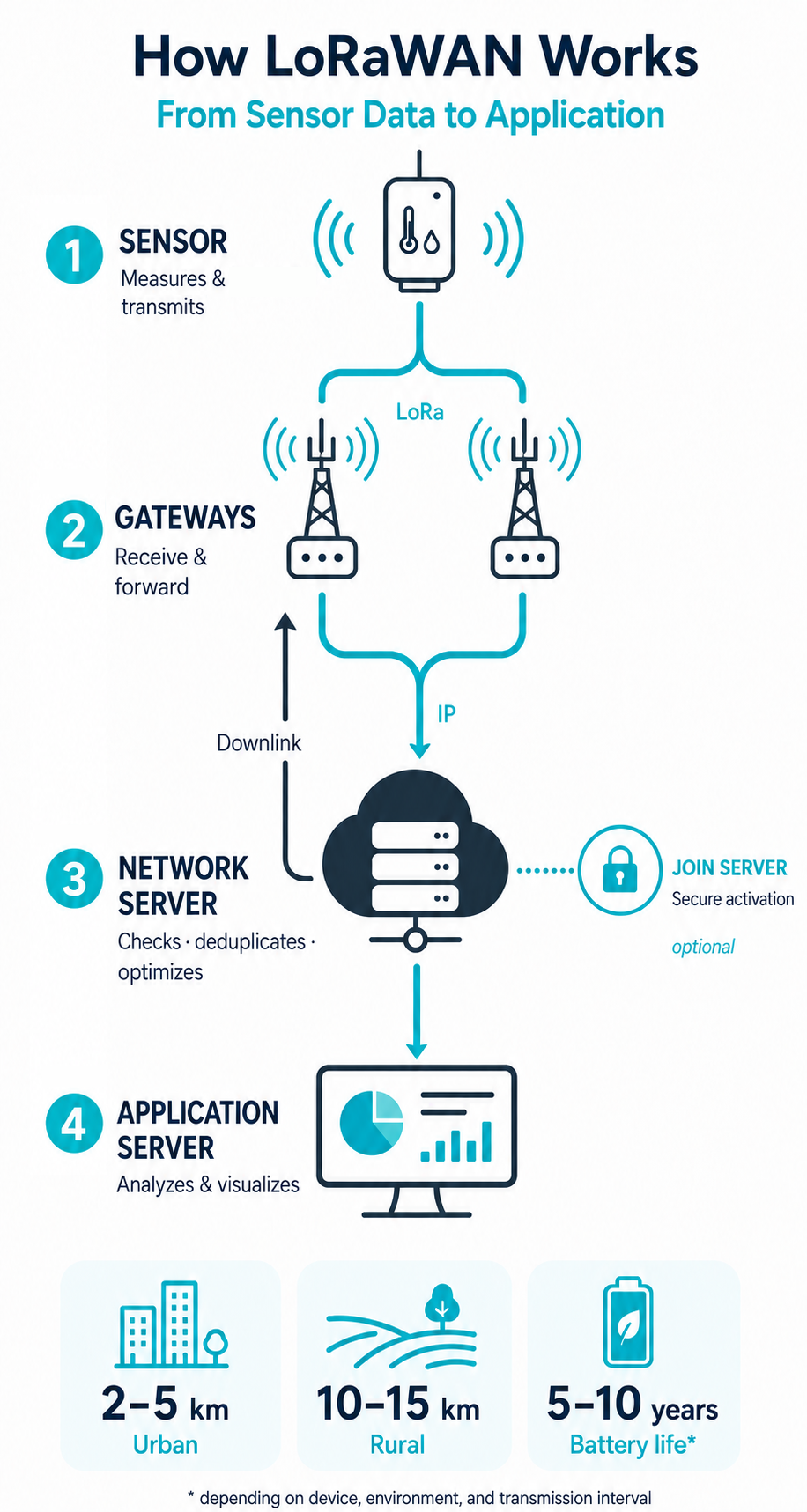
End devices are the actual “data sources” in the network. These include sensors, meters, trackers, or simple actuators. Technically, they are usually very simple and consist of the following components:
- Microcontroller
- LoRa radio module
- Power source (usually a battery)
These end devices are designed to spend most of their time in sleep mode and “wake up” only briefly for radio transmissions. They almost always initiate communication themselves and send their data indiscriminately to all gateways available nearby.
2. Gateways
Gateways form the interface between the LoRa radio network and the IP-based data world. They receive the radio signals from the end devices (via LoRa) and forward them unchanged to the network server. In effect, gateways simply pass on signals and act as digital intermediaries.
A LoRaWAN gateway does not make decisions at the application level and usually does not know the state of the devices. Since transmissions from a single end device can be received by several gateways at the same time, the reliability and radio coverage of the network increase.
3. Network Server
The network server is the central control unit of the LoRaWAN network. It receives data packets from all gateways, removes duplicates (caused by redundant receptions), checks the integrity of the messages, and manages the MAC layer of the protocol.
The goal is to use radio resources efficiently while ensuring stable communication.
4. Join Server (Optional)
The join server is responsible for secure device activation, especially when the activation process uses OTAA (Over-the-Air Activation). It manages the root keys of the end devices and derives the temporary session keys from them.
Moving this process to a dedicated server improves security and makes operation across different networks easier.
5. Application Server
The application server processes the decrypted payload data from the end devices and sensors. This is where the actual application logic takes place: data is stored, visualized, analyzed, or forwarded to other systems.
The application server is completely decoupled from the radio network, allowing multiple applications to use the same LoRaWAN network in parallel without any issues.
LoRaWAN Device Classes and Their Significance
Depending on the application, different device classes are used. In total, there are three classes of devices that mainly differ in terms of power consumption, reachability, and latency:
LoRaWAN Device Class A
All LoRaWAN end devices (sensors / nodes) must at least comply with the requirements of this device class. It is the most energy-efficient class because it remains in power-saving mode almost permanently and only occasionally “wakes up” to send or receive information—making it well suited for IoT applications where high latency is not a major concern.
LoRaWAN Device Class B
For device class B, regular time intervals or specific times can be defined during which the device switches to receive mode. This makes it possible to perform downlinks to many devices in a LoRaWAN network at a predefined time—for example to improve controllability or support scheduled remote maintenance—while also increasing power consumption.
LoRaWAN Device Class C
Devices in class C are practically always in receive mode and almost never in power-saving mode. They are continuously able to receive downlinks. This results in very low latency, but also very high power consumption. Such devices are typically connected to an external power supply.
In practice, most LoRaWAN sensors operate in device class A. Classes B and C are usually used only selectively for special purposes. Important: most end devices do not have a “fixed” class but can switch classes when needed—based on commands from the server.
How LoRaWAN Works in Practice
LoRaWAN technology is designed so that a large number of widely distributed end devices can reliably transmit data to central IT systems with minimal power consumption.
The “complexity” of the technology is deliberately concentrated in the network rather than the end devices. This architectural principle clearly distinguishes LoRaWAN from traditional point-to-point radio solutions or cellular networks.
The practical operation can be explained along the typical life cycle of an end device: from commissioning, to ongoing data traffic, to configuration changes and maintenance.
1. Commissioning and Device Activation
Before an end device can send data, it must be integrated into a LoRaWAN network. In practice, this usually happens via OTAA (Over-the-Air Activation).
- The device sends a join request, which is forwarded via gateways to the join server and network server.
- There, session keys are derived and temporary network parameters are assigned to the device.
This process has two advantages: first, security-relevant keys are not used statically in the device; second, an end device can be operated flexibly in different networks. Once the join process succeeds, the device is ready for operation.
2. Uplink Communication: Sending Sensor Data
The most common day-to-day operation is the uplink—that is, data transmission from the end device to the network. In practice, a sensor measures a value, such as temperature, fill level, or meter reading, and sends that information as a very small data packet.
Thanks to LoRa modulation, LoRaWAN sensors achieve an effective range of 2–5 kilometers in urban areas and 10–15 kilometers in rural areas. Transmission is unidirectional and non-addressed: the message is received by all gateways within range.
Each gateway forwards the packet to the network server. There, duplicate receptions are identified and merged. The end device itself does not know which gateways or which server it is communicating with—and it does not need to.
After processing at the network layer, the data is handed over to the application server. Only there does the actual application logic take place, such as storing the data, triggering alarms, or forwarding it to other IT systems.
3. Downlink Communication: Responses and Control Commands
Downlinks—messages from the network to LoRaWAN sensors—are deliberately limited. They are permitted only in defined receive windows in order to keep power consumption and radio load for the nodes as low as possible.
In practice, LoRaWAN downlinks are used mainly to change configuration parameters (for example, the device class), answer status requests, or send simple control commands.
The network server decides through which gateway a downlink is sent—usually via the gateway with the best radio connection to the end device. This ensures efficient use of the available bandwidth and low data usage.
4. Adaptive Data Rate (ADR) and Network Optimization
Mechanisms such as Adaptive Data Rate (ADR) are essential for making optimal use of the available bandwidth. In practice, ADR works as follows:
- The network server analyzes the reception quality of previous transmissions and automatically adjusts the data rate and transmit power of the end devices.
- Devices with good radio connections send faster and at lower power, while distant or shielded devices receive more robust settings.
As a result, ADR increases network capacity, reduces the power consumption of the end devices, and improves the overall stability of the network—especially in large deployments with many thousands of sensors that are either sleeping or communicating.
5. Maintenance, Scaling, and Long-Term Operation
Because the technology is designed for minimal power use and very small data volumes, LoRaWAN networks are almost “built for” long-term operation.
New end devices can be added at any time using join requests without disrupting existing installations. Firmware updates, configuration changes, or class changes are carried out in a controlled way via the network.
For operators, this means that once a LoRaWAN network is built, it can grow for years and be configured as needed, while maintenance effort per end device remains very low.
An important point of contact for anyone interested in implementing a successful LoRaWAN solution is The Things Network. This is a global community ranging from private users to large corporations and includes many stakeholders who work successfully with LoRaWAN—either for personal use or as a core part of their business model.
What Are the Advantages of LoRaWAN?
Looking at its technical features, it becomes clear that LoRaWAN was specifically developed for IoT applications with many distributed end devices, small amounts of data, and long operating lifetimes. A compact overview of the advantages of this technology highlights that clearly:
- Great range with little infrastructure
LoRaWAN sensors can reliably transmit data over several miles, enabling effective coverage of large areas with only a few gateways. - Very low power consumption
End devices and sensors send only briefly and spend most of their time in power-saving mode. Battery lives of several years are realistic (for class A devices) and greatly reduce maintenance effort. - Low operating costs
Because they operate in license-free ISM bands, separate SIM cards, cellular contracts, and spectrum licenses are not required for the devices and sensors. - High scalability
A single gateway can serve thousands of end devices. Small payloads and infrequent transmissions ensure efficient use of radio resources. - Reliable above- and below-ground coverage
Sensors can easily transmit data even from basements, shafts, parking garages, or industrial environments, where other radio technologies often fail. - Open standard and large ecosystem
The standard is deliberately open, giving customers in all industries access to a broad range of hardware and platform options without forcing them into vendor lock-in. - Security by design
LoRaWAN provides native end-to-end encryption. In addition, clearly separated keys for the network and application layers are part of the standard.
In summary, the strength of LoRaWAN is deliberately not high data throughput but rather the efficient, reliable, and economical connection of very many end devices over long distances. That exact combination of technical features makes the standard especially attractive for numerous IoT applications.
LoRaWAN – Application Examples and Use Cases
The following use cases show how the characteristics and advantages of LoRaWAN technology can be used in practice:
Use Case 1: Smart Metering for Energy and Water Utilities
Private, municipal, and city utilities frequently use LoRaWAN for the remote reading of electricity, gas, and water meters. Modern meters are equipped with battery-powered LoRaWAN modules and send their consumption data at fixed intervals—for example once per day or several times per week.
Technical implementation: The meters send their measurements to nearby gateways, which forward the data to the network server. Because the data volume is so small and the transmissions are infrequent, the devices can operate for many years without a battery change. Downlinks to the devices are required only rarely, for example for configuration changes.
Value: Manual readings—such as in rented apartments—are almost completely eliminated. This enables very precise billing while also allowing anomalies such as leaks or unusual consumption patterns to be identified very quickly.
Use Case 2: Smart City and Parking Management
With the help of LoRaWAN sensors, aspects such as street lighting can be controlled very flexibly. Ground sensors—whether in parking garages or on public parking spaces—can also reliably identify whether a parking space is occupied or free and pass that information directly to the server via a LoRaWAN gateway.
Technical implementation: The sensors usually operate as class A devices and transmit only a few bytes per message. Several gateways provide redundancy across the city area. The data is then aggregated in the application server and forwarded to apps, control systems, or open data platforms.
Value: Traffic can be managed more efficiently, “parking search traffic” is reduced, and cities gain a cost-effective way to digitally monitor distributed infrastructure.
Use Case 3: Asset Tracking and Condition Monitoring in Industry
In industrial sites and logistics centers, LoRaWAN is used to monitor machine conditions, containers, or mobile assets. LoRaWAN sensors measure things like temperature, vibration, or fill level and automatically report deviations to connected systems.
Technical implementation: Mobile or stationary sensors send data either event-based or cyclically. In combination with geolocation functions, assets can also be roughly located without permanently active GPS.
Value: Companies gain transparency into the status and location of their assets. At the same time, downtime can be reduced and maintenance and logistics processes can be optimized on a data-driven basis.
The Weaknesses: Where Are LoRaWAN’s Limits?
There are many good application fields for LoRaWAN technology—but precisely because it is so efficient, it also has clear limits. The following examples illustrate that:
- Very low data rates and small payloads
LoRaWAN is suitable only for small, infrequent messages. Typical payload sizes are in the tens to low hundreds of bytes. Large data volumes, audio, video, or continuous measurement data cannot be transmitted meaningfully using this technology. - High latency and no real-time capability
Communication is event-based or interval-based. Anyone who needs real-time control for systems or devices will necessarily have to look for a different technology. - Severely limited downlink capacity
Downlinks are limited both technically and by regulation. Applications should therefore be designed primarily so that neither frequent commands nor bidirectional dialogues between devices are required. - Regulatory constraints (duty cycle)
In license-free ISM bands, duty-cycle rules limit the transmission time per device. This necessarily limits message frequency. And the more heavily the frequencies are used, the more precisely transmission intervals need to be planned in advance. - Firmware updates only with limitations (FUOTA)
Large or frequent updates are time- and energy-intensive. Every larger FUOTA (Firmware Update Over The Air) process involves multiple steps and usually requires splitting the update into multiple fragments.
In short: LoRaWAN technically struggles in all the areas it was not originally designed for. High data throughput, the need for low latency, or true real-time communication quickly push the system to its limits.
Frequency Channels and Regional Parameters – How Transmission Is Regulated
Because LoRaWAN uses license-free ISM bands, it is very cost-effective but at the same time subject to a range of regulations and requirements:
- Regional frequency bands
There is no single “international” frequency on which all LoRaWAN sensors or gateways are allowed to communicate. In Europe, the relevant bands are in the EU863–870 range; in the U.S., they are in the US902–928 range. For interested readers, the LoRa Alliance provides non-exhaustive overviews of frequency plans. - Mandatory default channels
On the device side, certain mandatory channels must be supported (for example 868.1 / 868.3 / 868.5 MHz in Europe) so that devices can join a network using join requests. - Duty-cycle constraints (EU)
In Europe, the transmission time (airtime) per device is limited (typically 0.1% to 1%, depending on the sub-band). This means only short, infrequent transmissions are allowed. The goal is to ensure that the license-free ISM bands can be used fairly by many devices. - Payload limitations
In addition to maximum transmission time per (sub-)band, the maximum size of each transmission is often strictly limited. Depending on the application, this generally ranges from 50 to 242 bytes per message. Best practice: the higher the spreading factor of a message, the smaller it should be in order not to block the frequency band unnecessarily.
This means that anyone who wants to use LoRaWAN devices worldwide must ensure that those devices are designed for operation in the ISM frequency bands that are valid in each respective region.
LoRaWAN Frequency by Country
| Country | Frequency band and suggested LoRaWAN channel plan |
|---|---|
| Australia |
|
| Brazil |
|
| Canada |
|
| Germany |
|
| India |
|
| Philippines |
|
| United Kingdom |
|
| United States |
|
| Vietnam |
|
| Other Countries |
October 2025, Table 1. This overview lists unlicensed frequency bands and
suggested channel plans. Current national regulations always take precedence.
Conclusion: When Is LoRaWAN the Right Choice?
LoRaWAN is a very strong option when companies—or public-sector organizations—want to connect a large number of sensors to a single network in a cost-effective, standardized, and energy-efficient way.
The strengths of LoRaWAN lie in its very large coverage area, strong building penetration, often multi-year battery life (depending on device class), and open standardization, which guarantees a high degree of technological freedom.
FAQ: Frequently Asked Questions about LoRaWAN
How long does the battery last in sensors / end devices?
Battery life in a LoRaWAN sensor depends heavily on the transmission interval, data rate, sensor type, and temperature.
For typical class A sensors, battery life of several years (5–10 years) is often realistic, because the devices spend most of their time “asleep.” For class B devices, battery life often ranges from several months to about a year. Class C devices are typically practical only with external power.
Who standardizes LoRaWAN?
The standard is further developed by the LoRa Alliance. It defines specifications, regional parameters, and certification procedures. Certified devices behave predictably in compliant networks and can therefore be combined easily with gateways, network servers, and platforms from different manufacturers.
How secure is LoRaWAN?
LoRaWAN technology is generally regarded as secure because the radio standard natively supports end-to-end encryption. At the same time, device authentication and separate keys for the network and application layers are built in.
The decisive factor for the security of such a network is, above all, a technically clean implementation and the proper configuration of the devices involved.
How does LoRaWAN enable tracking without GPS?
LoRaWAN can use radio data from several gateways, such as signal strength or time differences in reception. This makes it possible to determine a rough position even without permanently active GPS. This is practical when coarse location data is sufficient instead of exact geolocation.
cetecom advanced is a global testing and certification service provider and part of the RWTÜV Group.
We are a state-recognized testing laboratories that is accredited worldwide for a wide range of testing services. With our testing services in accordance with international regulations, we help to bring electrical/electronic products safely onto the international market. Furthermore, we carry out product approvals in over 180 countries and renowned brands from all industries have been relying on our expertise since 1993.
This technical article was written according to strict editorial standards. All information contained in the article is the result of careful research on the subject. All specialist articles have been checked by the relevant specialist departments in our laboratories, which are responsible for testing and approving a wide range of radio products on a daily basis.